What Are Your Ads Really Telling You?
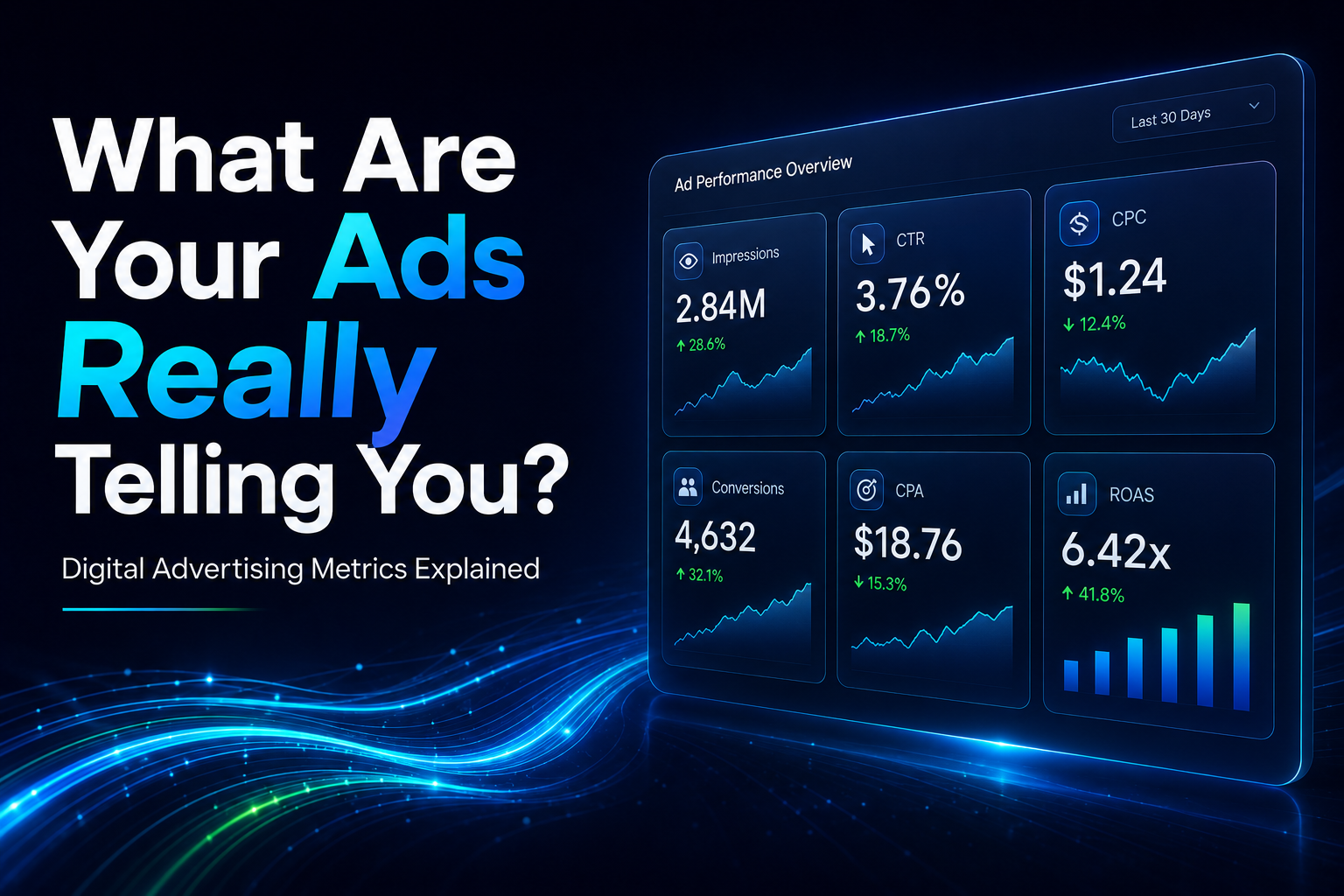
What Are Your Ads Really Telling You?
A practical guide to understanding digital advertising metrics, measuring real performance, and knowing what the numbers actually mean
What Are Your Ads Really Telling You? is a question every business running digital advertising should be able to answer.
Advertising platforms generate enormous amounts of data. Impressions, clicks, click through rate, cost per click, conversions, conversion rate, cost per acquisition, return on ad spend, reach, frequency, and dozens of other metrics can all appear inside a campaign dashboard.
The problem is that numbers without context can be misleading.
A campaign can generate thousands of clicks and very little business. Another campaign may generate fewer clicks at a higher cost, yet deliver significantly better qualified leads and stronger commercial results.
The purpose of advertising measurement is therefore not to make every number look impressive. It is to understand the story the numbers are telling you about the customer journey.
At Blink Digital Consulting, we build advertising around measurable outcomes. Our Digital Advertising and PPC services connect campaign strategy, targeting, landing pages, conversion tracking, lead generation, CRM, and reporting so businesses can understand what happens from the first impression through to a genuine sales opportunity.
How Does Digital Advertising Actually Work?
Digital advertising allows businesses to pay for visibility across platforms such as Google Ads, Microsoft Advertising, LinkedIn Ads, Meta, and other digital networks.
Depending on the platform, advertisers can reach people according to search behaviour, location, professional information, interests, audience characteristics, previous website activity, or other targeting signals.
The customer journey then begins.
An advertisement is displayed.
Someone sees it.
They may click it.
They arrive on a website or landing page.
They may complete a form, make a call, book an appointment, request information, or purchase something.
Each stage creates a different advertising metric.
The easiest way to understand campaign performance is to read those metrics in the same order that the customer experiences them.
Stage One: Are People Seeing Your Advertising?
What Do Impressions Mean in Digital Advertising?
An impression is recorded when an advertisement is shown.
Google defines an impression as each occasion an advertisement appears on Google or across the Google Network. (Google Help)
If your campaign generates 20,000 impressions, it means the advertising was displayed 20,000 times.
It does not necessarily mean that 20,000 different people saw the advertisement because the same person may see it more than once.
Impressions answer one basic question:
Is the campaign getting exposure?
They do not tell you whether the advertising generated enquiries or customers.
What Is Reach?
Reach estimates how many individual people were exposed to the advertising.
This is why reach and impressions are different.
If one person sees the same advertisement four times, that can produce four impressions while the campaign may have reached only one person.
Reach helps you understand how broadly your message is being distributed.
What Does Frequency Mean?
Frequency indicates how often people are seeing the advertising.
If reach is 5,000 people and the campaign generates 15,000 impressions, the average frequency is approximately three exposures per person.
Frequency can be useful because customers often need repeated exposure before taking action.
However, extremely high frequency may indicate that the same audience is seeing the same advertising repeatedly without responding.
That can be a signal to review the audience, creative, message, or campaign structure.
Stage Two: Is the Advertising Generating Interest?
What Does a Click Mean?
A click is recorded when somebody clicks an interactive part of an advertisement.
Google notes that a click can be recorded even when the person does not ultimately reach the website, for example if the destination is temporarily unavailable. (Google Help)
Clicks tell you that the advertisement generated enough interest for someone to interact.
But a click is not a lead.
And a click is certainly not automatically a customer.
What Does CTR Mean?
CTR means click through rate.
It measures the percentage of impressions that resulted in a click.
The formula is:
Clicks ÷ Impressions × 100 = CTR
For example, if an advertisement receives 100 clicks from 5,000 impressions, the CTR is 2 percent.
Google describes CTR as a way to gauge how effectively advertisements and keywords are performing and states that what constitutes a good CTR depends on what is being advertised and the network being used. (Google Help)
CTR helps answer:
Are people finding the advertisement relevant enough to click?
A strong CTR with poor conversion performance can mean the advertisement is attracting attention but the traffic is not converting after arrival.
That is why CTR should never be viewed in isolation.
Stage Three: What Is That Traffic Costing You?
What Does CPC Mean?
CPC means cost per click.
Average CPC tells you the average amount paid for each click.
Google calculates average CPC by dividing the total cost of clicks by the total number of clicks. (Google Help)
For example:
Campaign spend: 5,000 units of local currency
Clicks: 250
Average CPC: 20 units of local currency
This example works whether the campaign is running in Canada, South Africa, or another market because the principle is the same.
A lower CPC is not automatically better.
A cheap click from someone who will never become a customer has limited commercial value.
A more expensive click from a highly relevant prospect can be substantially more valuable.
The important question is not simply:
How cheap are the clicks?
It is:
What are those clicks producing?
Stage Four: Are Visitors Actually Taking Action?
What Is a Conversion?
A conversion is an action the business has decided is valuable.
Google describes conversion tracking as measuring how advertising interactions lead to meaningful actions such as purchases, leads, calls, sign ups, or downloads. (Google Help)
For a service business, conversions might include:
• Completed consultation forms
• Telephone calls
• Appointment bookings
• Quote requests
• Qualified enquiry submissions
• Completed applications
For an ecommerce business, the primary conversion may be a purchase.
The critical issue is deciding which actions genuinely matter.
If a business counts every button click as a major conversion, the campaign may appear successful while producing very little commercial value.
What Does Conversion Rate Mean?
Conversion rate tells you how frequently an eligible advertising interaction produces a conversion.
Google calculates conversion rate by dividing conversions by eligible advertising interactions. (Google Help)
For example:
500 eligible interactions
25 conversions
Conversion rate: 5 percent
Conversion rate is one of the most useful metrics for understanding what happens after traffic arrives.
A strong CTR combined with a weak conversion rate may point to problems such as:
• Poor landing page alignment
• An unclear offer
• Weak calls to action
• Excessive form friction
• Poor mobile usability
• Low quality traffic
• A disconnect between the advertisement and landing page
This is why advertising should not operate independently from the rest of the marketing system.
Blink Digital Consulting connects advertising with broader digital growth services, including lead generation, CRM, automation, SEO, and conversion focused digital experiences.
Stage Five: What Is Each Result Costing?
What Does CPA Mean?
CPA means cost per action or cost per acquisition, depending on how the campaign is configured and discussed.
Google calculates average CPA by dividing the total cost of conversions by the number of conversions. (Google Help)
If campaign spend is 10,000 and the campaign produces 20 conversions:
Average CPA = 500
But whether 500 is good or bad depends on what that conversion represents.
A qualified consultation request for a high value professional service may justify a substantially higher acquisition cost than a low value transaction.
Context determines value.
What Is Cost Per Lead?
Cost per lead tells you what you are spending to generate an enquiry.
But businesses should go one step further.
Cost per qualified lead is often more commercially useful.
Imagine two campaigns.
Campaign A generates 20 leads at a lower cost, but only two are genuinely relevant.
Campaign B generates 10 leads at a higher cost, but seven become legitimate sales opportunities.
The cheaper campaign is not necessarily the better campaign.
Stage Six: Is the Advertising Creating Business Value?
What Does ROAS Mean?
ROAS means return on ad spend.
A simple calculation is:
Tracked revenue or conversion value ÷ Advertising spend = ROAS
For example:
Advertising spend: 10,000
Tracked revenue: 50,000
ROAS: 5
The campaign generated five units of tracked revenue for every one unit invested in advertising.
Google supports conversion values specifically so advertisers can understand business impact rather than simply counting every conversion equally. (Google Help)
ROAS is particularly useful when revenue or reliable conversion values can be tracked.
For lead generation businesses, however, the journey may continue beyond the advertising platform.
That is where CRM data becomes important.
The Metric Advertising Platforms Cannot Fully Explain: Lead Quality
Advertising platforms are exceptionally good at measuring digital interactions.
They do not always know whether an enquiry became a serious business opportunity.
A dashboard may show 50 conversions.
But what happens if:
15 leads were irrelevant.
10 were outside the service area.
8 could not be contacted.
7 were genuine but not ready.
10 became qualified sales opportunities.
That information changes how the campaign should be evaluated.
This is why Blink Digital Consulting connects advertising with CRM and Automation.
The advertising platform tells you what happened before and around the conversion.
The CRM helps tell you what happened after it.
Frequently Asked Questions About Digital Advertising Metrics
What Is the Most Important Advertising Metric?
There is no single metric that is always the most important.
The correct metric depends on the campaign objective.
Awareness campaigns may prioritize reach and impressions.
Traffic campaigns may examine clicks, CTR, and CPC.
Lead generation campaigns should focus more heavily on conversions, conversion rate, cost per qualified lead, and sales opportunities.
Revenue focused campaigns may prioritize conversion value and ROAS.
Is a High CTR Always Good?
No.
A high CTR indicates that people are clicking the advertising, but those clicks still need to produce meaningful actions.
A high CTR combined with poor lead quality may indicate that the advertisement is attracting the wrong audience or setting the wrong expectation.
Is a Low CPC Always Better?
No.
CPC measures the cost of traffic, not the value of the customer.
Higher cost traffic can still outperform cheaper traffic if it produces stronger conversion rates and better customers.
What Is the Difference Between a Click and a Conversion?
A click is an advertising interaction.
A conversion is an action the business has identified as valuable, such as an enquiry, booking, call, or sale.
Google explicitly separates these concepts in its advertising reporting. (Google Help)
How Do You Know if Digital Advertising Is Working?
Look beyond one metric.
A strong campaign should create a logical progression:
Visibility → Engagement → Conversion → Qualified Opportunity → Business Value
If impressions are high but nobody clicks, investigate the advertising.
If clicks are strong but conversions are weak, investigate the landing page and offer.
If conversions are strong but sales are poor, investigate lead quality, CRM processes, and follow up.
Can AI Help Analyse Advertising Performance?
Yes, AI assisted advertising platforms increasingly use campaign data to support bidding, targeting, creative optimization, and conversion modelling.
But AI still depends on the quality of the signals it receives.
If a business measures poor quality actions as valuable conversions, automated systems may optimize toward those actions.
Accurate tracking and business context remain essential.
Advertising Metrics Tell a Story
Digital advertising metrics are not simply numbers on a dashboard.
They describe different stages of the customer journey.
Impressions tell you whether you are being shown.
CTR tells you whether people are responding.
CPC tells you what that attention costs.
Conversion rate tells you whether traffic is taking meaningful action.
CPA tells you what those actions cost.
ROAS helps connect advertising investment with tracked business value.
Lead quality tells you whether those results actually matter.
The strongest advertising analysis brings these metrics together.
At Blink Digital Consulting, we help businesses connect Digital Advertising and PPC, lead generation, CRM, automation, conversion tracking, and reporting into one measurable system.
Because the objective is not to make an advertising dashboard look busy.
It is to understand what your ads are really telling you, and what you should do next.
Blink Digital Consulting
Blink Digital Consulting helps businesses generate qualified leads, improve online visibility, automate follow-up, and build digital marketing systems that work around the clock.