The 7 Critical Checks Behind a Connected Growth System
The 7 Critical Checks Behind a Connected Growth System
Marketing rarely fails at one dramatic moment.
More often, a promising opportunity slips through a small gap: the business appears in search but does not earn the click; a visitor lands on the website but cannot quickly understand the offer; an enquiry reaches an inbox but receives no timely response; or a campaign reports leads without showing whether any became customers.
Every tool may look active. The customer journey is still disconnected.
That is the problem a connected growth system is designed to solve.
What Is a Connected Growth System?
A connected growth system is a coordinated customer acquisition journey that links discovery, trust, conversion, lead capture, CRM, follow up, sales ownership and measurement. Its purpose is to help the right prospect move from first contact to a clear business outcome without being lost between channels, tools or teams.
In practical terms, the system connects:
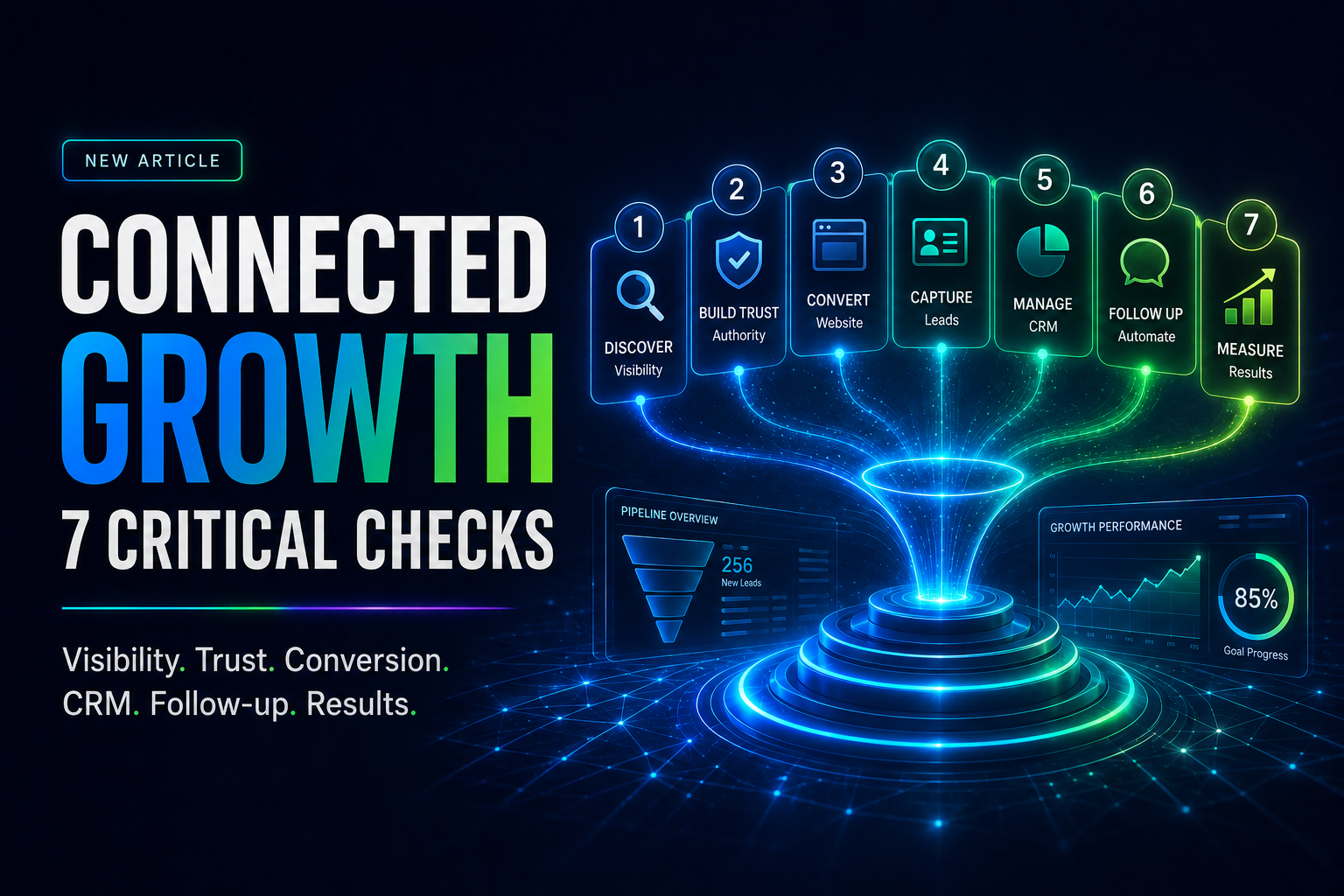
Discovery → Trust → Click → Enquiry → Response → Next Step → Outcome
This is different from simply collecting more marketing software. A website, advertising account, CRM and automation platform do not create a system merely because they exist. They become a system when information passes between them accurately, each handoff has an owner, the next action is clear and the result can be measured.
The seven checks below follow that complete journey. They are not seven isolated services and they are not a rigid funnel. They are diagnostic checkpoints for finding the constraint that is limiting growth, fixing it in the right order and verifying whether the change produces a better result.
The Seven Connected Growth Checks at a Glance
Growth leaks: Where are suitable prospects disappearing?
Search and AI visibility: Can customers and discovery platforms find and understand the business?
Follow up system: What happens immediately after an enquiry?
Clicks to customers: Does the post click journey turn relevant attention into action?
Lead system: Are capture, qualification, routing and ownership connected?
Proof and results: Is marketing being measured against meaningful business movement?
Audit and priorities: Which constraint deserves attention first?
1. Growth Leaks: Find Where Good Opportunities Disappear
Before buying more traffic or launching another campaign, inspect what happens to the attention the business already receives.
A growth leak is any point where a suitable prospect is willing to continue but the process makes the next step unclear, difficult, slow or unconvincing. The leak may be technical, commercial or operational.
Common examples include:
A relevant page is difficult for search engines to access or understand
The business appears in search, but the result does not earn attention
The website attracts the right visitor, but the offer is vague
An advertisement makes a promise the landing page does not continue
A form asks for too much information too early
A valid submission reaches the wrong inbox, pipeline or team member
The prospect receives no acknowledgement and does not know what happens next
Follow up stops after one attempt
Dashboards report activity without connecting it to qualified opportunities
The first job is not to add more activity. It is to map the current journey honestly.
At every handoff, ask four questions:
What should happen here? Define the intended next action.
What actually happens? Test the real journey rather than relying on the diagram.
How do we know? Identify the event, record or outcome that proves the step worked.
Who owns the next action? Make responsibility visible.
This exercise often exposes a costly pattern: the business keeps investing at the top of the journey while preventable gaps at the bottom continue to waste good opportunities.
Blink Digital Consulting approaches SEO, advertising, conversion, CRM and automated follow up as parts of one measurable growth system, not as unrelated marketing tasks.
2. Search and AI Visibility: Win Consideration Before the Website Visit
People form opinions about a business before they visit its website.
They may encounter a Google result, map listing, review profile, directory entry, social page or AI generated answer first. These surfaces influence whether the business appears relevant, credible and worth investigating.
Modern visibility therefore involves more than ranking one page for one keyword. A business needs a clear, consistent and well supported digital identity across traditional search, local discovery and AI assisted experiences.
The strongest foundations include:
Technically accessible, indexable pages
Specific descriptions of services, products, locations and audiences
Content that answers real customer questions directly
Consistent business, location and entity information
Structured information that helps machines interpret the page correctly
Credible reviews, references and authority signals
Clear authorship and evidence where expertise matters
Strong local relevance when geography influences the decision
Traditional SEO remains essential because search engines and AI systems still depend on accessible, understandable and trustworthy information. AI visibility adds a related question: is the business represented clearly enough to be identified, evaluated and potentially referenced in an answer?
No ethical provider can guarantee a particular organic ranking, AI citation or recommendation. The practical goal is to improve the signals that make a business easier to find, understand and trust.
Explore Blink’s approach to SEO and GEO AI visibility.
3. Follow Up System: Make Every Genuine Enquiry Feel Expected
A form submission is not the end of lead generation. It is the beginning of a new part of the customer journey.
From the prospect’s perspective, the question is simple: did anybody receive my enquiry, and what happens now?
A reliable follow up system should answer that question quickly and accurately. It should:
Acknowledge the enquiry. Confirm that the request was received without pretending a personal review has already taken place.
Preserve the context. Retain the source, campaign, service interest and relevant form answers.
Route the lead correctly. Place it in the correct pipeline and notify the person responsible.
Guide the next step. Explain whether the prospect should reply, provide information, submit a request or wait for a personal response.
Continue appropriately. Follow up at sensible intervals without ignoring replies, preferences or opt outs.
Stop when circumstances change. A reply, booking, unsubscribe, disqualification or completed sale should alter the workflow.
Automation is most useful when it supports a human sales process. It should improve speed and consistency while making it easier for a person to step in with the right context.
The details matter. A beautifully designed form is still broken if a field is mapped incorrectly, the internal notification contains blank information or a delayed workflow continues after the prospect has replied.
See how Blink connects lead routing, pipeline visibility and communication through CRM and marketing automation.
4. Clicks to Customers: Fix the Journey After the Click
Clicks are an input. Customers are an outcome.
That distinction sounds obvious, but it changes how marketing performance should be assessed. A campaign can generate large volumes of inexpensive traffic and still produce very little commercial value. Another campaign may attract fewer visitors but create more qualified enquiries and better sales opportunities.
When traffic increases but results do not, inspect the complete conversion chain:
Intent → Message → Page → Offer → Action → Follow Up → Result
Look for alignment at every step:
Is the campaign reaching people who can realistically become customers?
Does the search result or advertisement make a promise the page actually fulfils?
Can the visitor understand the value without decoding vague language?
Is there enough legitimate proof to reduce uncertainty?
Is the call to action appropriate for the visitor’s level of intent?
Does the form collect the information needed for follow up without creating unnecessary friction?
Does conversion tracking measure a meaningful action rather than a convenient click?
Does the lead receive a prompt, relevant and clearly owned next step?
The objective is not simply to make a landing page look better. It is to make the right action easier for the right person while giving the business enough information to respond properly.
For a deeper explanation, read Why More Clicks Do Not Mean More Customers.
5. Lead System: Connect Capture, Qualification and Ownership
A form is not a lead system. A CRM is not a lead system. An advertising campaign is not a lead system.
A lead system is the complete operating path that moves a suitable prospect from interest to a managed opportunity. It connects:
Attraction through search, social, referrals or paid media
A message that matches the prospect’s intent
A focused page or conversion destination
Accurate, privacy conscious lead capture
Qualification using criteria that matter to the business
Routing to the correct person, pipeline or process
Timely communication across suitable channels
Visible pipeline stages and next actions
Outcome tracking that feeds back into marketing decisions
Every valid lead should have an owner, a current status and a measurable next step. Without those three things, information accumulates while opportunities quietly become stale.
The most important design question is not, “Which software should we buy?” It is, “What should happen when a suitable prospect raises a hand?” The technology should then be configured around that answer.
Explore Blink’s connected lead generation systems.
6. Proof and Results: Measure Business Movement, Not Marketing Motion
A connected system needs evidence. Without it, marketing becomes a collection of opinions, attractive dashboards and activity reports.
Useful measurement follows the customer journey:
Visibility: Are the right people discovering the business?
Engagement: Are they interacting with relevant pages and offers?
Enquiries: Are valid prospects taking a meaningful action?
Response: Are leads acknowledged, routed and contacted appropriately?
Pipeline: Are qualified opportunities progressing?
Commercial outcomes: Are bookings, purchases, customers or revenue being recorded where the data allows?
Not every sale can be attributed neatly to one click. Long sales cycles, offline conversations, repeat visits and multiple decision makers make attribution imperfect. The answer is not to abandon measurement. It is to define what can be measured reliably, disclose what cannot and avoid presenting estimates as certainty.
Proof should also be specific and contextual. Blink’s published work includes an air conditioning campaign reporting 312% lead growth and a 14.5% advertising conversion rate, and an education campaign reporting 202 LinkedIn leads at ZAR 39.06 per lead. These results belong to their individual campaigns, markets and periods. They are evidence of completed work, not a promise that another business will reproduce the same numbers.
Review Blink’s case studies and published results.
7. Audit and Priorities: Identify the Next Best Fix
By this point, the central question should be clearer:
Which constraint is stopping the customer journey from working as one system?
A useful audit should not hide the answer behind a vague score or overwhelm the business with an unprioritised list of possible changes. It should explain:
What was reviewed
What is working
What is missing or unreliable
Why the gap matters
What evidence supports the finding
What should be addressed first
How the result will be checked after implementation
Blink’s free AI Visibility Audit is designed to examine how a business is positioned across search and AI assisted discovery. The review covers search visibility, AI readiness, technical accessibility, local presence, content and entity clarity, authority signals and competitive gaps. The resulting action plan is intended to show what deserves attention first rather than providing another unexplained score.
Visibility is a practical starting point because discovery sits at the beginning of the connected journey. Its findings should then be considered alongside the website, offer, lead capture, CRM, follow up and sales process.
Request a free AI Visibility Audit.
How to Find the Weakest Handoff This Week
You do not need to rebuild the entire marketing operation at once. Start with one real customer journey and follow it from beginning to end.
Choose one important service, product or campaign.
Search for the business as a prospective customer would.
Open the relevant result on both desktop and mobile.
Complete the main conversion action using a dedicated test contact.
Confirm exactly where the submission appears.
Measure how long acknowledgement and human response take.
Check whether the correct context, owner and next action are preserved.
Review what the dashboard counts as a conversion.
Identify the first handoff that is unclear, unowned or unproven.
Fix that point, test the journey again and then move to the next constraint. This is usually more valuable than adding another channel to a system that has not yet proved it can handle the opportunities it already receives.
The System Is Only as Strong as Its Weakest Handoff
The seven checks work together:
Find the growth leaks.
Strengthen search and AI visibility.
Make follow up dependable.
Turn relevant clicks into clear next steps.
Connect capture, qualification and ownership.
Measure genuine business movement.
Audit the gaps and prioritise the next best fix.
A connected growth system does not eliminate every imperfect lead, uncertain attribution path or human delay. It creates a disciplined way to see those problems, decide what matters and improve the journey using evidence.
That is how marketing stops merely looking busy and starts contributing to a more reliable growth process.
Frequently Asked Questions
What Is a Connected Growth System?
A connected growth system links discovery, trust, conversion, lead capture, CRM, follow up, sales ownership and measurement into one managed customer journey. It reduces the gaps between marketing activity and measurable business outcomes.
Why Can a Business Get Traffic Without Generating Enough Customers?
Traffic creates an opportunity, not a customer. Results also depend on audience quality, message to page alignment, the strength of the offer, trust, ease of conversion, accurate tracking, timely follow up and the business’s sales process.
Is AI Visibility Separate From SEO?
No. SEO and AI visibility share foundations such as technical accessibility, clear content, entity information, relevance and authority. AI visibility adds emphasis to whether a business can be identified, understood and potentially referenced in AI assisted answers and recommendations.
What Should a Reliable Lead System Include?
A reliable lead system should connect attraction, a relevant offer, accurate capture, qualification, routing, CRM ownership, timely follow up, pipeline visibility and outcome tracking. Every valid lead should have an owner, a status and a next action.
Which Marketing Metrics Matter Most?
The most useful metrics follow the journey from qualified visibility and engagement to valid enquiries, response, pipeline progression and commercial outcomes. Clicks and impressions remain useful diagnostic measures, but they should not be treated as final proof of growth.
Where Should a Business Start Improving Its Marketing System?
Start at the earliest point where a suitable prospect is currently being lost. That may be poor visibility, an unclear offer, a weak landing page, a faulty form, slow follow up, missing ownership or incomplete measurement. Fix and verify that handoff before adding more activity.
Does an Audit Guarantee More Leads, a Number One Ranking or an AI Recommendation?
No. An audit identifies gaps, evidence and priorities. Rankings, AI recommendations and commercial results depend on implementation quality, competition, market conditions, the offer and the wider customer journey.
Ready to Find the Constraint Limiting Your Growth?
If the first concern is whether customers and AI assisted discovery platforms can find and understand the business, request your free AI Visibility Audit.
If the challenge extends across the wider customer journey, submit a connection request and tell Blink Digital Consulting what you want to improve. Every request is reviewed to determine whether there is a suitable next step. Submitting the form does not automatically book a meeting or create an obligation.
Blink Digital Consulting
Blink Digital Consulting helps businesses generate qualified leads, improve online visibility, automate follow-up, and build digital marketing systems that work around the clock.