Google Ads in 2026
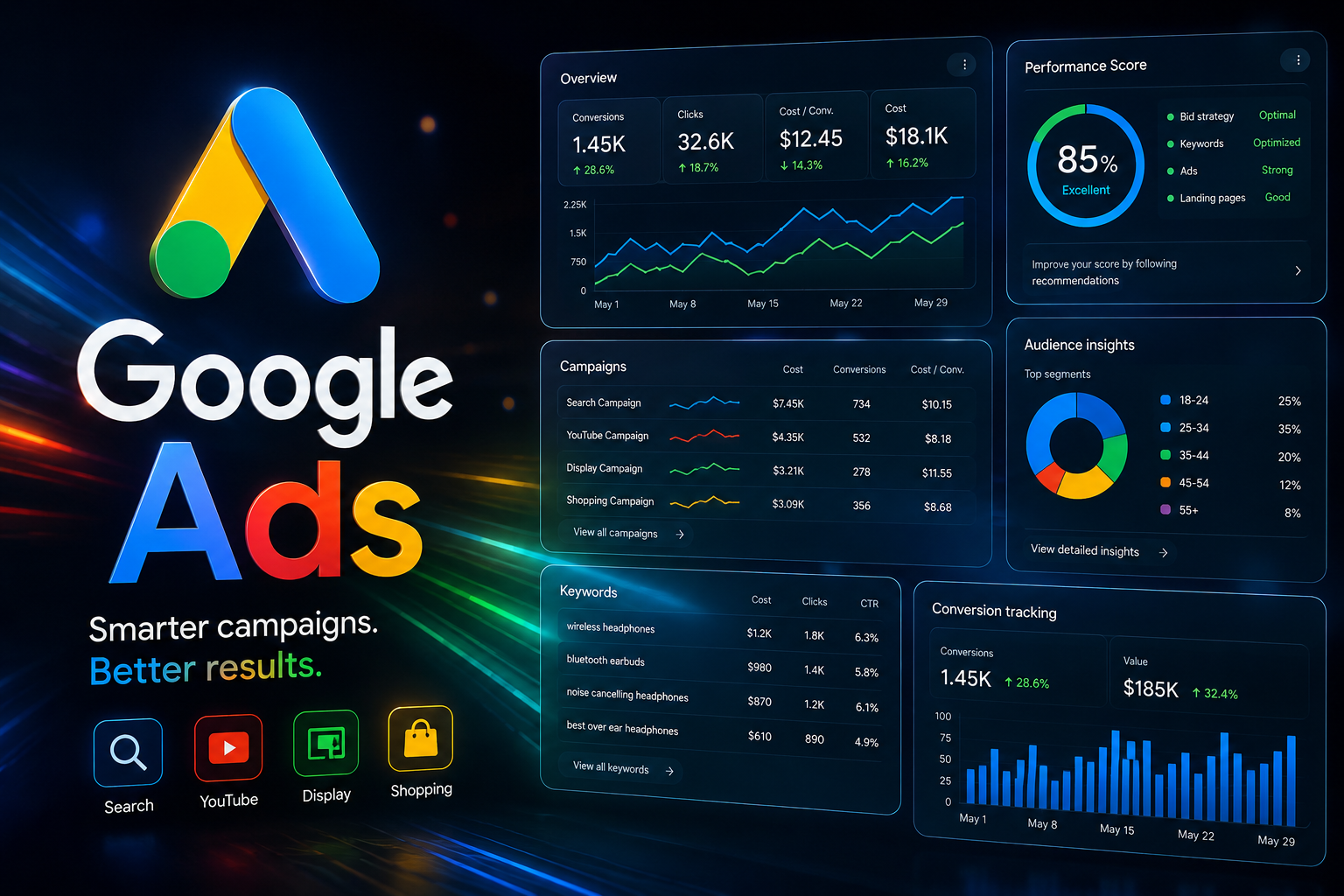
Google Ads in 2026
Google Ads in 2026 is no longer just about choosing keywords, writing ad copy, setting a budget, and waiting for clicks. The platform is changing quickly, and the businesses that adapt first will have a clear advantage. Google Ads is becoming more AI driven, more automated, more connected to the full customer journey, and more dependent on the quality of a business’s website, landing pages, tracking, and follow up systems.
For business owners, this shift creates a simple but important question. Are your campaigns built for how digital advertising works today, or are they still running on an older version of paid media strategy?
At Blink Digital Consulting, we help businesses build smarter marketing systems that connect visibility, advertising, lead generation, CRM automation, and conversion tracking. That matters because paid advertising today does not work in isolation. A Google Ads campaign is only as strong as the system around it.
The New Reality of Google Advertising
Google Ads has always evolved, but 2026 is different because AI is now built into more of the advertising process. Google is using AI to help match ads to more complex search intent, improve bidding, generate and optimize assets, expand campaign reach, review policy issues faster, and connect advertisers with users across more Google surfaces.
That does not mean businesses can simply switch on automation and expect better results.
AI can improve performance when it is guided by a clear strategy, strong campaign structure, accurate conversion tracking, relevant landing pages, and proper audience signals. Without those foundations, automation can quickly spend budget on the wrong traffic, weak leads, or conversions that do not translate into real business value.
This is why Blink Digital Consulting takes a systems based approach to paid media. Our Digital Advertising PPC service is built around campaign planning, audience targeting, budget control, landing page alignment, A/B testing, and performance optimization.
Clicks matter, but they are not the final goal. Qualified leads, booked calls, sales opportunities, and measurable return on ad spend matter more.
AI Max Is Changing Search Campaigns
One of the biggest Google Ads changes businesses need to understand is the move toward AI Max for Search campaigns.
Google introduced AI Max for Search as a feature suite that uses AI to expand search term matching, customize text assets, and send users to more relevant final URLs. In simple terms, Google is moving Search campaigns beyond the traditional model of only targeting a fixed list of keywords.
This matters because people are searching in more detailed and conversational ways. A potential customer may not type the exact keyword an advertiser expected. They may ask a longer question, compare options, describe a specific problem, or use a phrase that still shows strong buying intent.
AI Max is designed to help advertisers capture more of that intent while still giving them controls around brand, location, and messaging. Google has also confirmed that Dynamic Search Ads will be upgraded to AI Max, with the Dynamic Search Ads sunset and automatic upgrade now beginning in February 2027. Google has stated that campaigns using Dynamic Search Ads, automatically created assets, and campaign level broad match settings will begin moving toward AI Max from September 2026.
For business owners, the lesson is clear. Search campaigns need stronger inputs than ever before.
Your website content needs to be clear. Your landing pages need to match the services you are advertising. Your location targeting must be accurate. Your conversion actions must be properly defined. Your campaign data must show Google what a good lead actually looks like.
A poorly structured website and weak landing pages can limit the value of AI driven campaigns. A clear website, strong service pages, and focused landing pages give Google better signals to work with.
That is why paid advertising should work alongside SEO and AI visibility, not separately from it.
Performance Max Is Getting More Useful Reporting
Performance Max has been powerful for many advertisers, but it has also been frustrating because it historically gave limited visibility into where ads were serving and which channels were driving results.
That is changing.
Google announced that channel performance reporting is now available in Performance Max campaigns, giving advertisers more visibility into how different Google channels contribute to performance. This is important because Performance Max can serve across multiple Google surfaces, including Search, YouTube, Display, Discover, Gmail, Maps, and Shopping placements where applicable.
For businesses, better reporting means better decision making.
If a campaign is spending budget across multiple channels, the advertiser needs to understand what is actually contributing to leads and conversions. More transparency helps agencies and business owners evaluate whether the campaign is supporting the right goals, reaching the right people, and producing the right kind of engagement.
However, better reporting does not remove the need for proper strategy.
Performance Max still works best when it has strong creative assets, clear audience signals, accurate conversion tracking, and a realistic understanding of the customer journey. If the campaign is optimized around weak conversion actions, such as low quality form fills or accidental clicks, it can learn from the wrong signals.
This is where Blink Digital Consulting focuses heavily on tracking and conversion quality. Our work does not stop at campaign setup. We look at how traffic moves through the funnel, how leads are captured, and how follow up happens after the enquiry.
For businesses that want to turn traffic into real enquiries, Lead Generation Systems are a critical part of the advertising equation.
Demand Gen Is Replacing the Old Display Mindset
Another major shift is Google’s continued movement from traditional display thinking toward Demand Gen campaigns.
Google has positioned Demand Gen as a campaign type designed to help advertisers create and convert demand across visually engaging Google surfaces such as YouTube, Shorts, Discover, Gmail, Maps, and the Google Display Network. Google has also stated that eligible advertisers can migrate Display campaigns to Demand Gen.
This reflects a bigger change in customer behaviour.
People do not always search first. They may discover a brand while watching YouTube, browsing content, checking Gmail, using Maps, or reading across Google surfaces. Later, they may search the business by name or compare it with competitors.
That means paid advertising needs to support more than one moment in the buyer journey.
Search campaigns are still important because they capture high intent demand. Demand Gen campaigns can support earlier stage awareness and consideration. Remarketing can help bring interested users back. Landing pages can convert that interest into action. CRM automation can keep the conversation going once the lead is captured.
This is why disconnected advertising is so risky. A business may be visible, but if the offer is unclear, the landing page is weak, or the follow up is slow, that visibility does not become revenue.
Blink Digital Consulting’s services are designed to connect these pieces so businesses can attract, capture, follow up with, and convert more opportunities.
Real Time Policy Reviews Are Speeding Up Campaign Launches
Google has also introduced Real Time Policy Reviews for Google Ads. This feature gives advertisers faster feedback while building text assets in Responsive Search Ads. Instead of waiting longer for certain policy checks after ads are submitted, advertisers can receive feedback during the creative process and when saving ads.
This is a practical improvement because campaign delays can cost businesses time, especially when they are launching seasonal offers, limited promotions, or urgent campaigns.
However, faster review does not mean advertisers can be careless.
Ads still need to follow Google’s advertising policies. Landing pages still need to be accurate and functional. Claims still need to be supported. Regulated industries still need extra care. Businesses should not use AI generated ad copy without reviewing it for accuracy, compliance, and brand fit.
This is especially important for industries such as healthcare, legal services, financial services, education, and professional services, where claims, wording, and location specific requirements matter.
At Blink Digital Consulting, accuracy matters because campaign speed should never come at the expense of trust. A campaign that launches quickly but uses weak claims, unsupported promises, or poor landing page content can create problems for both performance and credibility.
AI Powered Ads Need Human Strategy
Google is testing and expanding more AI powered advertising experiences, including new ad formats built with Gemini for Search. These updates are designed to make ads more helpful in AI driven search experiences and more relevant to the user’s specific query.
This is the direction digital advertising is moving.
Search is becoming more conversational. Users expect faster answers. Google is using AI to interpret intent, generate more relevant advertising experiences, and connect users with products, services, and businesses that match their needs.
But AI is not a replacement for human strategy.
A business still needs to know who it wants to reach, what problem it solves, what makes its offer credible, what locations it serves, what services it provides, and what kind of lead is actually valuable.
The stronger the business strategy, the better the campaign inputs. The better the inputs, the better the advertising system can perform.
This is where Blink Digital Consulting brings together digital advertising, SEO, CRM, automation, and conversion strategy. Google Ads can drive traffic, but the business still needs a system that turns that traffic into measurable opportunity.
Why Clicks Are Not Enough Anymore
One of the biggest mistakes businesses make with Google Ads is judging campaign success by clicks alone.
Clicks are not leads. Leads are not always qualified. Qualified leads are not always sales. Sales usually depend on the quality of the offer, the speed of follow up, the sales process, and the trust built before and after the enquiry.
A modern Google Ads strategy should measure more than traffic.
Businesses should be asking:
Which campaigns are generating qualified leads?
Which search terms are producing real enquiries?
Which landing pages are converting best?
Which channels are assisting conversions?
Which leads are moving into the CRM pipeline?
Which enquiries become booked calls or sales opportunities?
How quickly does the business respond?
What is the cost per qualified lead?
What is the estimated value of the pipeline generated?
Which campaigns deserve more budget?
Without these answers, businesses can waste money even when the dashboard looks active.
This is why CRM and automation are so important. When leads are captured properly, followed up quickly, and tracked through the pipeline, a business can make better decisions about its marketing spend.
How Blink Digital Consulting Helps Businesses Stay Ahead
Blink Digital Consulting helps businesses stay ahead of Google Ads changes by focusing on strategy first, not platform hype.
New Google Ads features matter, but they only create value when they are used in the right context.
For some businesses, the best starting point is a focused Search campaign targeting high intent buyer terms. For others, the opportunity may include Performance Max, Demand Gen, remarketing, landing page development, or CRM automation. The right mix depends on the business model, the budget, the service area, the competition, and the sales process.
Blink Digital Consulting helps clients by focusing on the core pieces that make paid advertising work:
Clear campaign objectives
Proper account structure
High intent keyword targeting
AI assisted campaign expansion where appropriate
Strong landing page alignment
Accurate conversion tracking
Budget management
Audience segmentation
A/B testing
Ongoing optimization
CRM integration
Lead quality review
This approach is important because the future of Google Ads is not less strategic. It is more strategic.
AI can help scale campaigns, but it needs clean data, strong messaging, and clear business direction.
The Local Business Advantage
For local and service based businesses, Google Ads remains one of the most direct ways to reach people who are actively looking for help.
Someone searching for an accountant, lawyer, clinic, HVAC company, training provider, or professional service is often already problem aware. They are not just browsing. They are comparing options and deciding who to contact.
That creates an opportunity, but only if the campaign is built properly.
A local campaign needs accurate location targeting, relevant ad copy, strong service pages, clear calls to action, and landing pages that match the user’s search intent. The campaign should also reflect the business’s local market, competition, terminology, and regulatory environment.
A campaign for a business in South Africa should not be written or structured the same way as a campaign for a business in Canada or the United States. Local relevance matters. So do platform rules, privacy expectations, industry standards, and market behaviour.
Blink Digital Consulting works with businesses in South Africa and North America, helping them build region appropriate marketing systems that support visibility, lead generation, and growth.
What Businesses Should Do Now
Google Ads is moving quickly, and business owners should not wait until changes affect performance before reviewing their campaigns.
Now is the time to ask whether your advertising system is ready for 2026 and beyond.
Start by reviewing your current campaigns. Look at your campaign structure, conversion tracking, landing pages, search terms, audience signals, creative assets, and reporting. Then look beyond the ad account. Review how leads are captured, how quickly your team follows up, how enquiries are tracked, and whether you know which campaigns are producing real sales opportunities.
If the answer is unclear, your advertising system needs work.
The businesses that succeed with Google Ads in 2026 will not be the ones that rely blindly on automation. They will be the ones that combine AI driven advertising tools with strong strategy, clean data, clear messaging, and reliable follow up.
Final Thoughts
Google Ads in 2026 is more advanced, more automated, and more connected to AI than ever before. AI Max is changing Search campaigns. Performance Max is becoming more transparent. Demand Gen is reshaping how businesses create and convert demand. Real Time Policy Reviews are speeding up campaign creation. Gemini powered ad experiences are pointing toward a more conversational future for advertising.
These changes are important, but they do not change the fundamentals of good marketing.
Businesses still need clear positioning, accurate tracking, strong landing pages, useful content, fast follow up, and a strategy that connects advertising to real business outcomes.
That is where Blink Digital Consulting helps businesses move ahead with confidence.
Instead of treating Google Ads as a disconnected traffic source, Blink Digital Consulting builds smarter marketing systems that connect visibility, paid advertising, lead generation, automation, and measurable growth.
Visit Blink Digital Consulting or explore our Digital Advertising PPC service to learn how a stronger Google Ads strategy can help your business turn clicks into qualified opportunities.
Read this article on LinkedIn
Blink Digital Consulting
Blink Digital Consulting helps businesses generate qualified leads, improve online visibility, automate follow-up, and build digital marketing systems that work around the clock.