AI First Websites Are Replacing Static Business Websites

AI First Websites Are Replacing Static Business Websites
Why modern businesses need websites, dashboards, automation, and AI ready systems working together
AI first websites are replacing static business websites because the way people search, compare, and choose companies has changed. A modern website now needs to support search visibility, AI discovery, lead generation, CRM automation, dashboards, reporting, and measurable business growth. For businesses that still treat their website as a digital brochure, the risk is clear. Visibility becomes harder, leads become harder to track, and marketing decisions become less accurate.
AI First Websites Are Replacing Static Business Websites
A business website used to be simple. You needed a homepage, a few service pages, an about page, a contact form, and basic search engine optimization. That structure may still exist, but it is no longer enough. AI First Websites Are Replacing Static Business Websites because today’s digital environment demands more from every page, every form, every call to action, and every piece of data.
The modern website is no longer just a place where people read about a business. It is where search engines understand the business, AI systems interpret its authority, prospects compare its credibility, forms capture demand, CRM systems manage the lead journey, and dashboards help owners see what is working.
That is the real shift. Businesses are not only competing for website traffic anymore. They are competing for visibility inside search engines, AI generated answers, local discovery, paid advertising environments, social platforms, and automated sales journeys.
Google’s own guidance confirms that generative AI features in Search, including AI Overviews and AI Mode, still rely on core search systems, indexing, content quality, and technical structure. Google states that “The best practices for SEO continue to be relevant” for generative AI search, which means AI visibility is not replacing SEO. It is making strong SEO, better structure, and useful content more important.
The Static Website Problem
Many businesses still have websites that look acceptable but do very little commercially. They may explain the company, list services, show a few images, and offer a contact form. That might create a basic online presence, but it does not create a complete digital growth system.
A static website usually has several limitations.
It does not clearly show which marketing channels produce leads.
It does not connect enquiries to a structured CRM pipeline.
It does not automatically follow up with prospects.
It does not help a business understand which services are driving interest.
It does not track the full journey from search, ad click, form submission, booking, and sale.
It does not provide useful dashboard visibility for decision making.
It may also fail to communicate clearly with AI systems that are trying to understand what the business does, where it operates, who it helps, and why it should be trusted.
This is why website development in 2026 cannot be treated as a design only exercise. A website that looks modern but cannot capture, connect, track, and support business growth is still incomplete.
What an AI First Website Really Means
An AI first website does not mean adding a robot graphic to the homepage or placing a chatbot on every page. It means building a website that is structured for the way modern discovery, automation, and decision making now work.
An AI first website needs clear content, strong service architecture, technical SEO, fast performance, structured information, user focused pages, conversion points, analytics, CRM integration, and reporting visibility.
Google’s official AI search guidance highlights the importance of crawlability, technical clarity, useful content, page experience, and clear site structure. It also warns against chasing unsupported shortcuts or treating AI search as a separate hack from proper SEO.
That is important because many businesses are being sold surface level AI tactics. In reality, AI visibility starts with the fundamentals. If a website is unclear, thin, slow, poorly structured, or disconnected from the business’s real services, AI systems and human users will both struggle to interpret its value.
Development Now Means More Than Building Web Pages
For Blink Digital Consulting, this is where development becomes more strategic.
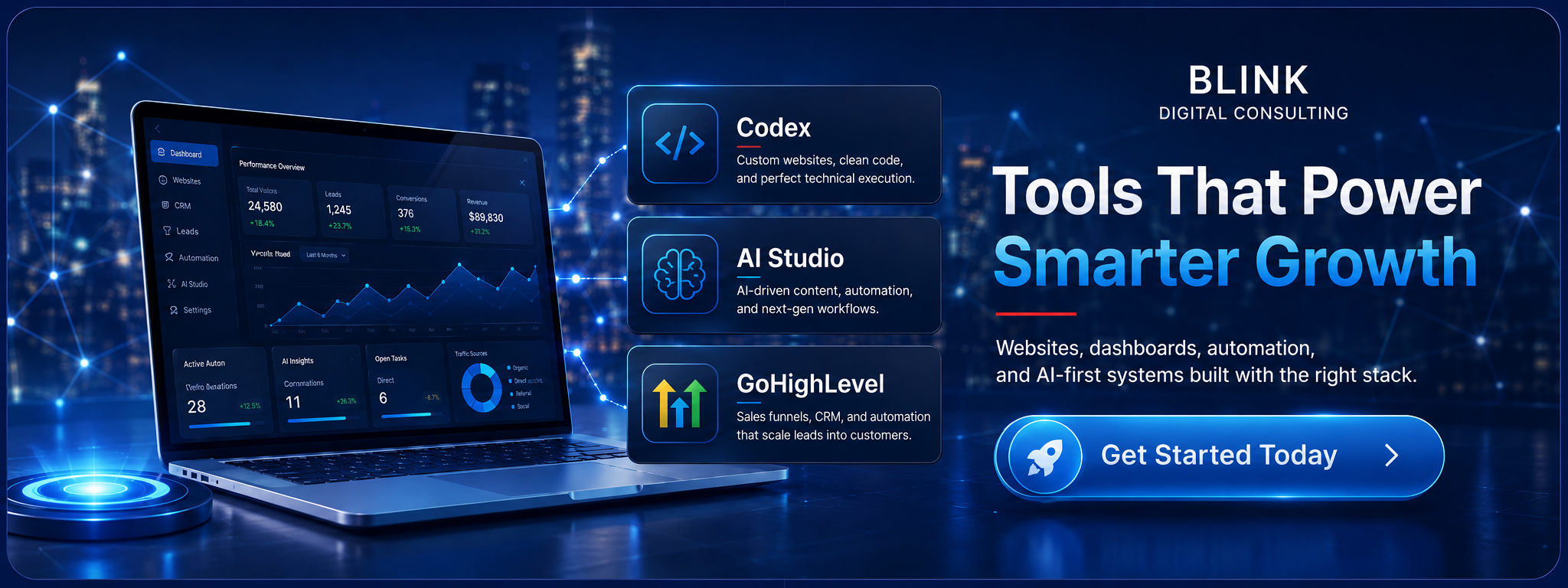
Website development is no longer only about building pages. It is about building digital infrastructure. That can include websites, landing pages, CRM connected forms, conversion funnels, client dashboards, reporting systems, internal apps, booking workflows, automations, review systems, AI assisted lead handling, and business intelligence dashboards.
A business may need a new website, but the real problem may be deeper.
The leads are not being followed up quickly.
The sales team does not know where enquiries came from.
The owner cannot see which campaigns are profitable.
The website content does not support AI search visibility.
The CRM pipeline is unclear.
The advertising campaign has no clean conversion tracking.
The business has no dashboard that connects activity to revenue.
This is why modern development needs to sit closer to marketing strategy. A website should not be built in isolation. It should connect to the way the business attracts, captures, nurtures, converts, and measures opportunities.
Why Dashboards Matter More Than Ever
AI has increased the amount of data businesses can access, but more data does not automatically create better decisions. In many cases, businesses have too many disconnected platforms and not enough clarity.
A modern dashboard should help answer practical business questions.
Where did our leads come from?
Which campaigns created enquiries?
Which website pages are generating interest?
How many leads entered the CRM?
How many booked a call?
How many moved into the sales pipeline?
Which services are getting the strongest demand?
Where are we losing opportunities?
This is where dashboards become a commercial tool, not just a reporting extra. They help business owners move from guessing to measuring.
Microsoft’s Bing Webmaster Tools introduced AI Performance reporting in public preview in 2026, showing how content appears as citations across Microsoft Copilot, Bing AI generated summaries, and selected partner integrations. This matters because AI search visibility is becoming something businesses can increasingly track, not just discuss.
That is a major signal for digital strategy. Businesses will need to monitor not only rankings and traffic, but also AI citations, cited pages, grounding queries, and the pages that AI systems reference most often.
The AI Prompts Businesses Should Now Care About
One of the most practical ways to think about AI visibility is to ask what potential customers might type into AI tools when they are researching a solution.
For Blink Digital Consulting, the tracked prompts should not only be broad SEO prompts. They should reflect real buying intent, service intent, and comparison intent.
Examples include:
“Who can help my business improve SEO and AI visibility?”
“Which digital marketing agency builds websites, dashboards, and CRM automation?”
“Who offers SEO, website development, and lead generation systems for small businesses?”
“What agency can build an AI ready website with reporting dashboards?”
“Which company can help a business appear in AI search results?”
These prompts matter because they show how search behaviour is becoming more conversational. People are not only typing short keywords. They are asking complete questions, comparing providers, and looking for recommendations inside AI assisted environments.
That does not mean businesses should write robotic pages for every possible prompt. Google specifically advises against overdoing content variations just to target every possible query. Instead, the stronger strategy is to build clear, expert led content that answers real customer questions with depth, credibility, and useful context.
Automation Turns Traffic Into Opportunity
Getting traffic is only one part of digital growth. The next question is what happens after someone lands on the website.
A visitor may complete a form, click a call button, book a consultation, request a quote, download a guide, or ask a question. If that action does not connect to a structured follow up process, the business can lose the opportunity.
This is why CRM automation has become essential. A connected system can capture the lead, assign it to the right pipeline, send confirmation messages, trigger reminders, notify the business, schedule follow ups, and track the opportunity through each stage.
For service businesses, this is especially important. Many companies do not lose because they have no demand. They lose because their demand is poorly managed.
An AI first website should therefore connect to the business’s actual sales process. The website, CRM, automations, and reporting dashboard should work together as one system.
AI Adoption Needs Structure, Not Random Tools
The AI conversation has created excitement, but it has also created confusion. Many businesses are testing AI tools without connecting them to measurable workflows, data systems, or commercial outcomes.
McKinsey’s 2025 State of AI research found that AI use is widening, including growing use of agentic AI, but many organizations are still working through the challenge of moving from pilots to scaled business impact. The research also links stronger AI value to practices such as workflow redesign, technology infrastructure, data infrastructure, KPI tracking, and embedding AI into business processes.
That point is directly relevant for business websites. AI is not valuable because it sounds advanced. It becomes valuable when it improves how a business works. That could mean faster lead response, clearer reporting, better customer journeys, stronger content visibility, improved internal workflows, or smarter decision making.
What Blink Digital Consulting Builds For This New Environment
Blink Digital Consulting helps businesses move beyond disconnected marketing activity. The focus is not only on building a website, running ads, or setting up a CRM. The stronger opportunity is to connect those elements into a measurable digital growth system.
That can include AI ready website development, search optimized service pages, conversion focused landing pages, CRM pipelines, lead capture forms, marketing automations, dashboards, reporting systems, app style tools, and digital infrastructure that supports real business decisions.
This is where the future of development is heading. Businesses need digital assets that can be found, understood, measured, and improved.
A website should help people understand the business.
Search engines should be able to crawl and index the website properly.
AI systems should be able to interpret the content accurately.
Prospects should know what action to take.
The CRM should capture and organize the opportunity.
Automations should support fast follow up.
Dashboards should show what is working.
That is the difference between a static website and an AI first business system.
The Businesses That Adapt Will Have The Advantage
AI First Websites Are Replacing Static Business Websites because the digital environment has changed. Search is changing. Customer behaviour is changing. Reporting expectations are changing. Business owners want clarity, not disconnected activity.
The businesses that win will not simply be the ones with the most modern looking websites. They will be the ones with websites that are structured, useful, measurable, connected, and ready for AI driven discovery.
A website can no longer sit separate from SEO, advertising, CRM, automation, reporting, and sales. It needs to become the centre of a connected digital growth system.
That is the opportunity for businesses now. Build a website that does more than exist. Build a system that helps people find you, understand you, contact you, and move through a better customer journey.
“The best practices for SEO continue to be relevant.”
Source, Google Search Central, guidance on optimizing websites for generative AI features in Google Search.
Blink Digital Consulting
Blink Digital Consulting helps businesses generate qualified leads, improve online visibility, automate follow-up, and build digital marketing systems that work around the clock.